 Genealogy of the Bristol Family Genealogy of the Bristol Family 
modified from BRISTOL GENEALOGY
compiled by W.E. Bristol
Bristol Family Association, 1967
(version February 3, 2019)
Please email corrections to Mike Clark

Most likely, the name Bristol - which is also spelled Bristow, Bristowe and Bristoll - originated as a place name for the seaport of Bristol in Gloucestershire, England. Harrison's "Surnames of the United Kingdom" (1912 & 1918) suggests that Bristow derives from the Anglo-Saxon word "bricq", which means bridge, and the word "stowe", which refers to a place - the combined meaning of which indicates a "bridge place". Although other origins for this name have been suggested, no proof exists for these, and Harrsion's interpretation seems the most reasonable.
English ancestors of the family adopted the spelling Bristow(e) in earliest times, and their descendents generally changed it to Bristoll upon arriving in America. Although Bristol is the prefered American spelling of the last century, older spellings persist in some parts of the country. Also, some indexes for the U.S. Census mispell the name as Brestel.
The parents of the Richard and Henry Bristow who follow are shown in many online genealogies as Daniel Bristol (b. c.1597) of Bath, Somerset and Hester Sperry (b. c.1598) of the same, who were married about 1623 in Bristol, Gloucestershire. However, there is never any reference given for these events. Seeing as how Henry Bristow’s son Daniel (1671-1738) did indeed marry a woman named Hester Speery, it is probably safe to say that the preceding parentage of the Bristow brothers is fiction.
Richard Bristow and his younger brother Henry arrived from England, probably separately, with Richard settling at Guilford in Connecticut, and Henry settling, somewhat later, in nearby New Haven. Richard was at Guilford when the first division of land took place, receiving "a parcel of upland and rocks" of about five acres, which after his death he left to his nephew Samuel. Richard took the freeman's oath early and generally worked as a barrel cooper. In addition, he held a small office in Guilford in 1650, where he served as an overseer of weights. Legend has it that the Bristow variety of apples are named after him, but his cannot be verified. He married twice, but outlived both wives and died childless in September of 1683. Because Richard had no children, his brother Henry is the immigrant ancestor of most American Bristols. (Smyth & Steiner, 1903, v. 53, p. 262-266)
Henry Bristow (Bristol), the younger brother of Richard, was born in England about 1625 and came to New Haven Colony as a stowaway, probably to join his brother in the colonies, just a few years after the settlement was founded. New Haven was first known as Quinnipiac, an Indian name, and was started in 1638 when a company of English Puritans led by the clergyman Reverend John Davenport (1597-1670) and the merchant and colonial administrator Theophilus Eaton (1590-1658) arrived there in search of religious freedom. The name was changed to New Haven in 1640 and was united in 1643-44 with the neighboring settlements of Guilford, Wilford, Branford, and Southold (on Long Island) to form New Haven Colony. These towns, except for Southold, became part of the Colony of Connecticut in 1664, and New Haven was chartered as a city within the newly created and independent state of Connecticut in 1784.
The government of the New Haven Colony that Henry lived in was of the strictest Puritan type and expressly excluded English statute and common law. The "worde of God was adopted as the only rule to be attended unto ordering the affayres of government in this plantation." Among the "blue laws" that governed the colony were:
- "the judges shall determine controversies without a jury"
- "married persons must live together or be imprisoned"
- "a wife shall be good evidence against her husband"
- "no minister shall keep school"
- "the selectmen, on finding children ignorant, may take them away from their parents and put them into better hands, at the expense of the parents"
Other laws forbade work, travel, joy on the Sabbath or fasting day.
Shortly after arriving in New Haven, Henry was indentured to William Davis, who was a barrel cooper like Henry's brother Richard. Henry was able to take the freeman's oath in March of 1646/47, presumably at the age of 21. He was, like all other New Haven colonists, a member of the congregation of Reverend John Davenport, one of the founders of the colony. Henry and his first wife Rebecca were assigned seats in Davenport's church, with Henry taking at first the seat "before Mr. Tuttle's" and later a seat "next to the soldiers". Rebecca was placed "in the seat before the little short seat".
Henry faced Puritan justice more than once. Colony records reveal that at a court session of October 2, 1659 "Henry Bristow because the scabbard of his sword was broke, so that the point came out which is dangerous, was fined 12d". In December of 1653, he was found innocent of a charge of sleeping while on watch. Although Henry was a barrel cooper by trade, he was appointed "a packer of flesh" on May 19, 1656 and faced the New Colony court again when he was cleared of a charge of "false meat packing".
Henry's home lot in New Haven sat at the present corner of Elm and Temple Streets, which in 1967 was occupied by the New Haven Public Library. His descendents lived there until Miss Mary Bliss Bristol sold the lot to the city. It is also recorded that on January 7, 1967 Henry bought from John Morris "be it more or less" 114 acres of land "on the west side of town", an area now known as West Haven. The minutes of a town meeting held in 1668 mention his land as being at Malbon's (Malebon's) Cove near the Oyster River, which forms the present boundary between West Haven and Milford.
Although Henry's main trade was that of a barrel cooper, he was also a fence-viewer in 1663, and was appointed in 1666 "to gage casks for this year", a job which fitted in with his profession of making wooden barrels. It was noted previous that he also tried his hand as a meat packer. Most likely, Henry's Malbon Cove plot was farmland, which indicates he may have done some farming as well, or at least leased it out to other farmers.
Several descendents of Henry Bristol fought in the American Revolution, among them his grandsons Aaron, Abel, and Eliphalet Bristol, the three of whom were brothers. The eldest brother Aaron (b. 1743) is one of the progeninators of the genealogy that follows. Aaron's son Moses Bristol (b. 1786), an uncle of the Harris line of descent, fought in the War of 1812.
Henry Bristow (c.1625-1695), the brother of Richard Bristow, was born about 1625 in England, and settled in the New Haven Colony of Connecticut shortly after its 1638 founding by the Puritan followers of Theophilus Eaton and John Davenport, who came in search of religious freedom. Aaron married his first wife Rebecca prior to 1649 in New Haven, and they had three children before her premature death sometime between 1653 and 1656. He married his second wife Lydia Brown, the daughter of Francis Brown (d. 1668) and Mary Edwards (d. 1669), on Jan. 29, 1656 in New Haven. Lydia, who was 15 or so years younger than Aaron, was born about 1637 or 1638 in either New Haven or Boston, her father Francis being one of seven settlers from the Eaton-Davenport company to spend the winter of 1637/38 at Quinnipiac, as New Haven was first known. Lydia died in 1719 in New Haven, probably having never traveled more than a few miles from her home her entire adult life. Henry preceded her in death, and died in 1695 in New Haven. Both were members of the New Haven First Church of Christ (Center Church), as were Lydia's parents, and almost certainly they are buried in the Center Church Cemetery. However, no trace remains of their tombstones.  Ref: Bristol (1967) p. 2, #1. Ref: Bristol (1967) p. 2, #1.
from the first marriage were born in New Haven:
Rebecca Bristol (1649-1739) married Zaccheus Candee (d. 1721) of West Haven in 1670 and had by him seven children.
Samuel Bristol (1651-1692) married Phebe and had by her four children. He inherited land from his uncle Richard Bristow.
Mercy Bristol (b. 1653) was born in 1653 and probably died young.
from the second marriage were born in New Haven:
Lydia Bristol (1657-1752) married first, in 1680, Joseph Smith (1655-1697) of West Haven, Connecticut and had by him five children. She married second, sometime after 1697, John Plumb.
John Bristol (1659-1735) married first Mehitable, and second Mercy Mansfield (b. 1662). John was licensed to sell liquor in 1701 and became a surveyor of highways in 1706. He had four children, probably from his second marriage with Mercy.
Mary Bristol (1661-1715) married a widower named Jobamah Gunn about 1689 and had by him three children.
Hannah Bristol (1663-1741/42) married Thomas Hinde of Milford in 1684 and had by him seven children.
Abigail Bristol (b. 1666) became in 1712 the second wife Daniel Terill (1689-1727) of Milford, Connecticut. Daniel, who was 23 years younger than Abigail, had ten children from his first marriage, but does not appear to have had any with Abigail.
Sarah Bristol (b. 1668) married Stephen Hine (b. 1663) of Milford, Connecticut and had by him four children.
Daniel Bristol (1671-1738) married first Esther (Hester) Sperry and second Judith Bunnell (d. 1746), the widow of Thomas Hodge. Eight children were born from the first marriage.
Elizabeth Bristol (b. 1674) died young.
Esther Bristol (b. 1676) died young.
Eliphalet Bristol (1679-1757), who follows:
Henry Bristol (1683-1750) married first in 1707 Desire Smith (d. 1740), and second Damaris Atwater (1700-1770) of New Haven, Connecticut in 1742 when he was about 59 years old. He had eleven children from his first marriage with Desire.
Eliphalet Bristol (1679-1757), the son of Henry Bristow and Lydia Brown, was born on Oct. 2, 1679 in New Haven, Connecticut and married Esther Peck (b. 1679), the daughter of Benjamin Peck and Mary Sperry. He was one of the original proprietors of Waterbury, Connecticut but never lived there. He took the freeman's oath of New Haven on April 30, 1717, and was chosen in Dec. 1717 to be a "viewer and hayward for the old field west side". He is listed in 1718 as a "lister", in 1718 as a surveyor, and in 1730 as a tithing man for West Haven. He died on Dec. 1757 having had several children. Ref: Bristol (1967) p. 5, #11.
children - BRISTOL:
Lydia Bristol (b. 1701) was born in 1701 and in 1723 married Joseph Crofut of Danbury, Connecticut.
Sarah Bristol b. 1703).
Dinah Bristol (b. 1705).
Stephen Bristol (1707-1785) in 1732/33 married a widow named Dorothy Tolles Brown (d. 1785) of West Haven and had five children. He was chosen a grand juror of West Haven in 1745 and became a surveyor of highways in 1751.
Abigail Bristol (b. 1709) married Joseph Pardee (1711-1766) of New Haven in 1737 and had seven children.
Eliphalet Bristol (1712-1805) married Sarah Thomas (1716-1796) in 1735 and had three children.
Aaron Bristol (1714-1791??), who follows:
Moses Bristol (1716/17-1802) married Rachel Trowbridge (b. 1719) of Stratford, Connecticut. He settled in Oxford, Connecticut and had nine children.
Esther Bristol (b. 1718/19) married a man by the last name of Stevens.
Benjamin Bristol (1721-1790 or 1810) married Thankful Trowbridge in 1745/46 and had five children. He lived in Connecticut and New York and served in the French and Indian Wars.
Aaron Bristol (1714-1791??), the son of Eliphalet Bristol and Esther Speck, was born on Aug. 31, 1714 in New Haven, Connecticut (Ref: Bristol, 1967, p. 22 & Jacobus, 1905, p. 169). His wife was named Abigail, according to Bristol (1967), and Jacobus (1905). However, Crane (1907), who is not regarded as highly as the aforementioned sources, identifies her as Eleanor Stiles. Aaron on April 7, 1755 took the freeman's oath for New Haven, and he was chosen on Dec. 13, 1756 to serve the town as a grand juror. He ultimately moved to Harwinton, Connecticut, and then sometime before 1790 to Panton, Vermont, where he is probably the Aaron Bristol living in Panton during the 1790 U.S. Census. Hall (1915, p. 68) states that, "Aaron Bristol was living in Panton, Vt., 1791, when he deeded land in Litchfield, Conn., to his son Aaron, also of Panton." Thus in 1791 Aaron, Senior was still alive, and living in Panton.
Supposedly the elder Aaron Bristol is buried in the Hawley Cemetery in Panton. However, there is no longer a tombstone there for him, nor one for his wife. Presumably, their tombstones were still standing back in the mid- to late 1800s when geneaologists first began researching the family, and we must take it on faith that they did not confuse the burial place of Aaron Bristol, Sr. with that of his son of the same name. Although Bristol (1967) and Jacobus (1905) only have a birth date for the elder Aaron Bristol, most online genealogies list 1791 as his death date. But because they never provide any evidence, this date must be considered speculative. All we really know for sure is that in 1791 he was still alive. He and Abigail had several children, all of whom were born in New Haven. Ref: Bristol (1967) p. 22, #43.
children - BRISTOL:
Reuben Bristol (1734-1828) married first in 1762 Comfort Barber (b. 1741) of Harwinton, Connecticut, and second Martha Butler (1741-1819), the widow of Samuel Bartholomew. Seven children were born, most likely all from the first marriage.
Miriam Bristol (1739-1826) married John Preston III of Windsor, connecticut.
Aaron Bristol (1743-1823), who follows:
Israel Bristol (1745-1796) married Phoebe Olmstead (1742-1828) and had two children.
Abigail Bristol (b. 1747).
Abel Bristol (1749-1867) married Mary Norton of Goshen, Connecticut in 1745. He fought in the American Revolution and was listed as a lieutenant in 1793 after the war was over. Later, in 1800 he advanced to the rank of captain with the New York Militia based in Columbia County. He had four children.
Eliphalet Bristol (1751-1833) married Sarah Scoville (1753-1826) of Harwinton, Connecticut in 1774. He fought in the American Revolution, serving with the Connecticut State Troops in Colonel E. Sheldon's regiment. According to one account, he was allowed 60 miles of travel pay for his horse during a 1779 skirmish at Danbury, Connecticut known as Tryon's Raid.
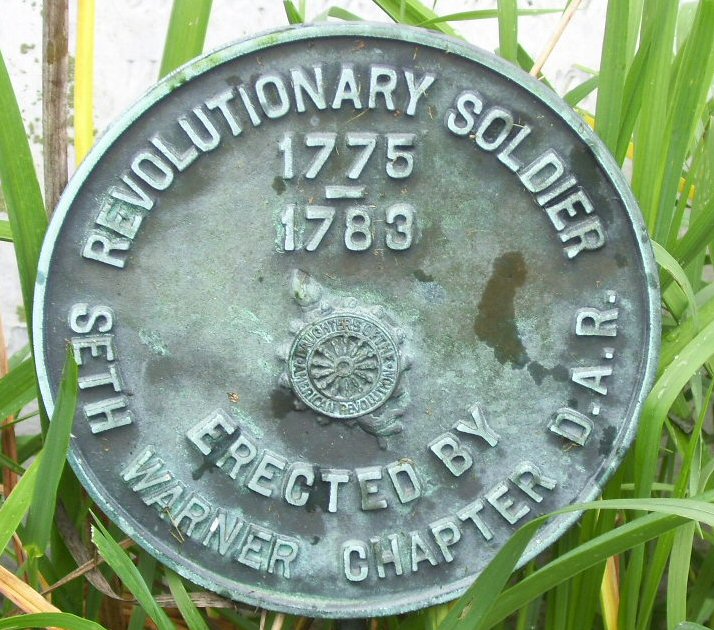 Aaron Bristol (1743-1828), the son of Aaron Bristol and Abigail, was born on May 7, 1743 in New Haven, Connecticut. After his family moved to Harwinton, Connecticut, he married Sybil Scovill (b. Oct. 10, 1748), the daughter of Ezekiel Scovill of Harwinton. Aaron is a Revolutionary War Veteran, having served first as a private in Capt. Amos Williams Company, and later in Colonel Gay's 2nd Battalian. Both he and his brother Abel apparently lost their guns in the York Island retreat of 1776. He resided for a time Harwinton, then moved to near the falls at Vergennes, Vermont where he built a log cabin (in Panton) and a brick one in 1822 or 1827. Aaron died on July 21, 1823 in Panton and Sybil on July 31, 1828. Both are buried in Panton in the Hawley Cemetery, where a double tombstone marks their graves, and the tombstones of their son Noah, and his wife Anna are nearby in the same group of five family graves. Ref: Bristol (1967) p. 36-37, #83.
children - BRISTOL:
Aaron Bristol (1769-1792) may have died single?
Sybil Bristol, of whom nothing further is known.
Chauncy Bristol (1775-1868) married Miriam (d. 1834) in 1798 and had eight children.
Levi Bristol (1777-1812/13) had a wife named Polly and two children.
Rhoda Bristol, of whom nothing further is known.
Lemon Bristol (1780-1811) had a wife named Betsy and two children.
Olive Bristol (b. 1782).
Moses Bristol (1786-1826) had a wife named Mary (c.1790-1843) and six children. He fought in the War of 1812 and was at the Battle of Pittsburgh. He died June 5, 1826 and is buried in the Hawley Cemetery in Panton.
Noah (1789-1838), who follows:
Noah Bristol (1789-1838), the son of Aaron Bristol and Sybil Scovill, was born on Sept. 26, 1789 in Panton, Vermont. He married on Feb. 27, 1814 Anna Stafford who had been on July 13, 1794. Noah died on May 12, 1838 in Panton, and Anna on Oct. 8, 1865 died there as well. Both are buried in Panton's Hawley Cemetery. Noah and Anna had several children, all of whom were born in Panton. Ref: Bristol (1967) p. 61-62, #164.
children - BRISTOL:
Philo Bristol (1815-1885) was born June 15, 1815, and married Prudence Rugg (1814-1892) of Greenfield, Massachusets or Lincoln, Vermont in 1835 and had nine children. He is buried in the Prospect Cemetery of Vergennes, not far from his brother Russel.
Lydia Bristol (1816-1820). She died April 8, 1820 and is buried in the Hawley Cemetery in Panton.
Philemon Levi Bristol (1818-1890) married first in 1838 Betsy Ann Jacobs (1818-1850) and second in 1851 Abigail Betsey Whittier (1819-1898). He had ten children and is buried in Greenwood Cemetery in Addison County, Vermont.
Abigail Bristol (1820-1898) married on March 16, 1840.
Russel Titus Bristol (1822-1900), who follows:
Sybil (1824-1868) married Watson Morgan (1821-1895) of New Haven, Vermont in 1846 and had six children.
Benjamin Stafford Bristol (1826-1848). He died Sept. 28, 1848 and is buried in the Hawley Cemetery in Panton.
Abel Bristol (1829-1891) married Abigail Thompson (1835-1915) in 1851 and had six children.
Lydia Bristol (1832-1876) married Charles Hayward.
Russel Titus Bristol (1822-1900), the son of Noah Bristol and Anna Stafford, was born May 29, 1822 in Panton, Vermont. He married Martha Jane Thompson (1828-1919), the daughter of James Thompson and Abigail Eldred in September of 1847 in New Haven, Connecticut. Russel was born and raised on the old Bristol farm that his grandfather Aaron Bristol had purchased around 1785 when he first came to Vermont from Connecticut. Russel inherited the farm from his father Noah and resided there for the remainder of his life. He gave his occupation on the census returns as farmer, but he was also a director for twenty years for the Bank of Vergennes, a selectman for the town, and he also ran a cash butter market in Vergennes for many years. He died on Dec. 20, 1900 in Panton; and Martha, who been born on Jan. 27, 1828 in New Haven, Vermont, died many years later on May 18, 1919 in Panton. Both are buried in the Prospect Cemetery of Vergennes, not far from Russel's brother Philo. Ref: Bristol (1967) p. 111-112, #352.
children - BRISTOL:
Willard Russel Bristol (1848-1925) was born on July 18, 1848 in Panton, Vermont, and on May 2, 1876 he married Mary Amelia Richards (1855-1938) in Panton. Willard died on March 9, 1925 in Vergennes, Vermont; and Mary, who had been born on Aug. 30, 1855 in Cornwall, Vermont, died on Oct. 18, 1936, probably in Vergennes. Both are buried in Vergennes in Prospect Cemetery. They had four children, including Walter Willard Bristol (1877-1945), who is buried with his parents in Prospect Cemetery.
Edwin Stafford Bristol (1849-1928) was born on Nov. 26, 1849 in Panton, Vermont. He married Alta Amelia Elitharp (1851-1945) on Jan. 30, 1888 in Panton. They had four children including Anna Bristol Evarts (1896-1877) and George H. Bristol (1901-1902). Edwin died on Jan. 15, 1928 and is buried in Vergennes, Vermont in Prospect Cemetery. Alta, who was born on March 7, 1851 in Bridport, Vermont, died on June 22, 1945 in Burlington. She is buried in Prospect Cemetery with Edwin, and their children Anna and George are buried nearby.
Ernest James Bristol (1852-1940) was born on March 1, 1852 in Panton, Vermont. He married his sister-in-law Susan Imogene Harris (1857-1943) on Jan. 9, 1878 in Panton, and they had seven children, including Mildred Bristol (1886-1889) and Milo E. Bristol (1897-1990). Ernest died on Nov. 16, 1940 in Panton, and he is buried in Prospect Cemetery in Vergennes, Vermont. Susan, who had been born on March 27, 1857 in Panton, died in Panton also on Dec. 20, 1943, and she is buried in Prospect cemetery with her husband and their children Mildred and Milo.
Carlton Doran Bristol (1854-1943) was born on Feb. 26, 1854 in Panton, Vermont. He married his first wife Anna May Elitharp (1853-1892) on March 13, 1875 in Panton. Anna, who had been born on May 14, 1853 in Bridport, Vermont, died on April 20, 1892 in nearby Vergennes. Carlton then married his second wife Caroline S. Stone (1868-1921) on Oct. 20th of the same year in Waltham, Vermont. Caroline, who had been born on June 26, 1868 in Monkton, Vermont, died before Carlton on Sept. 29, 1921 in Vergennes. Carlton died on May 29, 1933 in Vergennes, and he is buried with both wives and his sons Halsey (1878-1915) and Virgil (1894-1925) in Vergennes, Vermont in Prospect Cemetery. Carlton had at least four sons with Anna, and another two sons with Caroline.
Alice Jane Bristol (1855-1926), who follows:
Arthur Hiram Bristol (1857-1917) was born on Nov. 22, 1857 in Panton, Vermont. He married Adeline Sophia Kimball (1868-1941) on April. 22, 1896 in Middlebury, Vermont; and they had four children, including Elizabeth Bristol Dwire (1900-1965). Arthur died on July 14, 1917 in Waterbury, Vermont, and he is buried in Middlebury Cemetery. Adeline subsequently married Charles Gardner Cady (1849-1936) on Feb. 22, 1919 in Middlebury. Adeline, who had been born on June 14, 1867 in Orwell, Vermont, died on April 3, 1941 in Middlebury, and she is buried in Middlebury Cemetery with Arthur and Elizabeth.
Wallis (Wallace) H. Bristol (1859-1922) was born on Nov. 10, 1859, probably in Panton, Vermont. He married Cornelia Sibley (1863-1922) on March 17, 1885 in Panton, and they had nine children, including Mabelle Jane Bristol Eno (1887-1976). He was a jeweler. Cornelia, who was born on Feb. 6, 1863 in Essex County, New York, died on May 7, 1922 in Vergennes, Vermont; and Wallis died on April 4, 1927, probably saomewhere in the same County (Addison). Wallis, Cornelia and Mabelle are all buried in Vergennes in Prospect Cemetery.
Alice Jane Bristol (1855-1926), the daughter of Russel Titus Bristol and Martha Jane Thompson, was born on Dec. 24, 1855 in Panton, Vermont. She graduated from Middlebury College and married Rev. Sidney Munson Harris (1854-1937) on Sept. 29, 1881 in Panton. Sidney was a Methodist minister. who like Jane had been born in Panton. Jane and Sidney initially lived in Vermont, but moved to Massachusetts where for several years Sidney pursued a ministry. She also spent some time in London after the 1918 Armistice of World War I, but eventually returned to Panton where she died on May 25, 1926. Sidney outlived her by several years and passed away on Feb. 12, 1937 in Vergennes, Vermont, probably at the house of his son Sidney, Jr. Both are buried in the Prospect Cemetery in Vergennes. For the children of Alice and Sidney, please see the HARRIS GENEALOGY. Ref: Bristol (1967) p. 175, #605.
REFERENCES:
 The documentation for many of the dates and places listed in this history are found in the Ancestry.com online databases (subscription required).
Bristol, Theresa Hall et al. (1914-1915), "Bristol Notes", New York Genealogical and Biographical Record, New York Genalogical and Biographical Society, New York, v. 45 (1914), p. 68-73, 17-176 & 22-238; v. 46 (1915), p. 63-69 & 164-167.
- ______ (1915), ibid., v. 46, p. 68 (Corrections to "Aaron Bristol" in v. 45, p. 71)
Bristol, W.E. (1967), Bristol Genealogy: Bristol Family Association - This is the main reference upon which this lineage is based. This book can be purchased from the Bristol Family Association, and a digital version is available online at FamilySearch.org. Crane, Ellery Bicknell (1907), "Bristol Family" in Genealogical and Personal Memoirs of Worcester County, Massachusetts, Lewis Publishing COmany, New York, v. IV, p. 310-312. Cutter, William Richard, et al. (1911), "The Browne-Bristol Line" in Genealogical and Family History of the State of Connecticut, Lewis Publishing Company, New York, v. II, p. 1136. Cutter, William Richard, et al. (1913), "Brown" in New England Families - Genealogical and Memorial, Lewis Publishing Company, New York, v. IV, p. 1595. Grave and burial locations where known are listed with tombstone photos (when available) on  Hiram, Carleton (1903), Genealogical and Family History of the State of Vermont, Lewis Publishing Co., New York, p. 437-439 (Russell Titus Bristol). Jacobus, Donald Lines (1905), "Notes on the Family of Henry Bristol", The New England Historical and Genealogical Register, v. 59, p. 167-172. Smyth, Ralph D. and Steiner, Beranrd C. (1903), “Richard and Henry Bristow, or Bristol, of Guilford and New Haven, Conn., and their descendants”, The New England Historical and Genealogical Register, v. 53, p. 262–266.
|